Section 2 Dispositions
Where a public prosecutor decides to prosecute a person, they request a public trial or a summary procedure. A public prosecutor decides not to prosecute a person where [1] a precondition for prosecution (e.g., a victim’s complaint for certain offenses) is not satisfied, [2] the person’s act does not constitute an offense (or the person is not punishable due to insanity, etc.), or [3] there is insufficient evidence to prove an offense (including no evidence). [4] A public prosecutor may also decide not to prosecute a case even where there is sufficient evidence to prove an offense if it is deemed unnecessary to be prosecuted on the basis of factors such as a suspect’s character, age, environment, gravity of an offense and circumstances during or after an offense (suspension of prosecution).
Fig. 2-2-2-1 shows, in relation to persons conclusively disposed by public prosecutors (including negligent driving offenses causing death or injury and road traffic-related violations), the trend in the composition of such persons by type of disposition and the number and percentage of persons prosecuted for public trial.
Fig. 2-2-2-1 Persons disposed by public prosecutors: composition by type of disposition and number of persons prosecuted for public trial, etc.

Click here for the Excel file (Japanese)
Fig. 2-2-2-2 shows the trend in the number of persons prosecuted or not prosecuted and the prosecution rate for [1] Penal Code offenses and [2] Special Acts offenses excluding road traffic-related violations.
Fig. 2-2-2-2 Persons prosecuted, not prosecuted, etc.

Click here for the Excel file (Japanese)
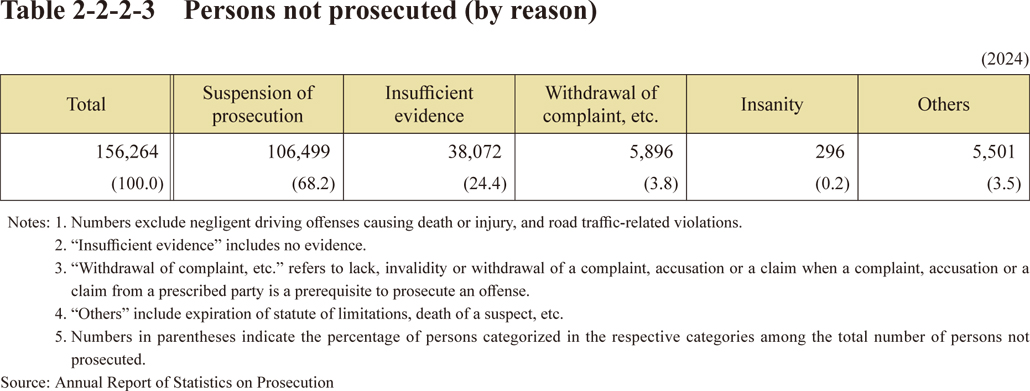
Table 2-2-2-3 shows the number of persons not prosecuted by reason of non-prosecution (excluding negligent driving offenses causing death or injury and road traffic-related violations) in 2024.
Table 2-2-2-3 Persons not prosecuted (by reason)